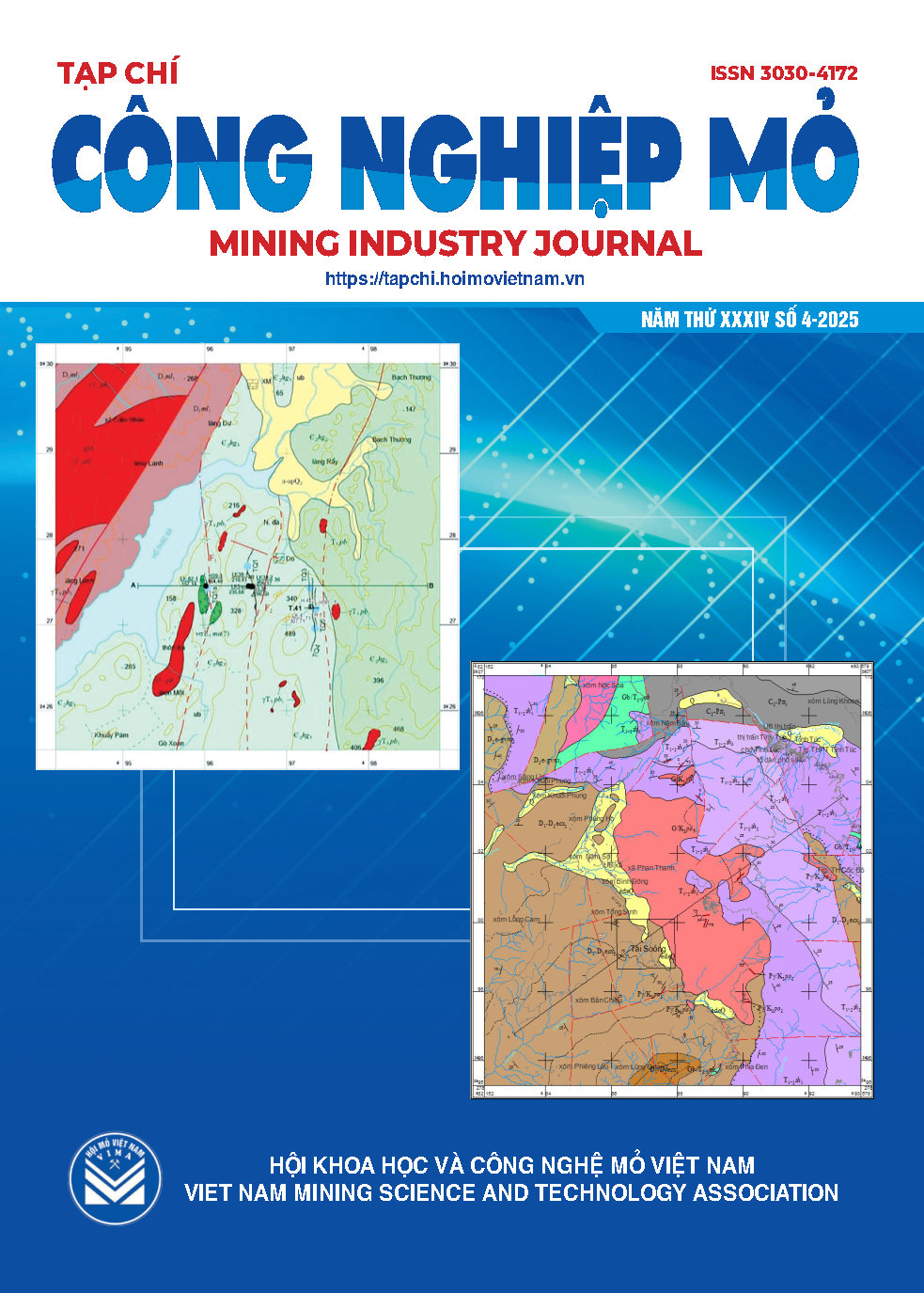
Geological characteristics and lead-zinc mineralization in the Cam Nhan area, Yen Bai
Keywords:
geological characteristics, lead-zinc mineralization, Cam Nhan, Yen Bai.Abstract
Based on the combined use of mineralogy and chemical analysis methods, combined with modeling methods, some conclusions are drawn about the geological and lead-zinc mineralization points in the Cam Nhan area as follows:
The study area has a complex geological structure, with the presence of formations belonging to the Ha Giang formation; the Mia Le formation and unconsolidated sediments of the Holocene and Quaternary systems. Acidic magma formations belonging to phase 1 of the Phia Bioc complex and mafic rocks of the Mau A complex are distributed over a fairly large area in the west and less in the center of the region.
Lead-zinc ores are distributed discontinuously, forming a mineralized zone extending from the Northeast to the Southwest and sub-meridional. The lead-zinc mineralized zone contains ore bodies that meet industrial requirements and are mainly related to faults in the northeast to the southwest and sub-meridional directions. The ores are concentrated in marble and altered dolomite marble belonging to group 3 of the Ha Giang formation.
The ore bodies primarily occur as veins, lens veins, and monoclines, predominantly towards the west and northwest with slopes ranging from 20 - 700; the thickness varies from 0.80 to 3.40m. The concentrations of lead (Pb) and zinc (Zn) in the ore bodies ranges from 0.048% to 16.5%, with averages of 0.124% to 3.343%, exhibiting significant and uneven variations.
The primary ore minerals include galena, sphalerite, pyrite, and lesser amounts of chalcopyrite, pyrrhotite, and magnetite; the non-ore minerals include calcite, dolomite, diopside, phlogopite, and quartz. The characteristic thermal metasomatism includes dolomitization, calcitization, quartzization, and talcization.
The ore has a low-medium temperature hydrothermal origin, with the symbiotic mineral assemblage, characterized by pyrite-sphalerite-galena during the industrial ore-forming phase
Downloads