
Urban Household Waste Segregation and the Implementation of the Sustainable Development Goals: A Case Study of Nguyen Du Ward, Hai Ba Trung District, Hanoi City
Keywords:
Waste Segregation, Urban Family, Sustainable Development, Urban Areas, HanoiAbstract
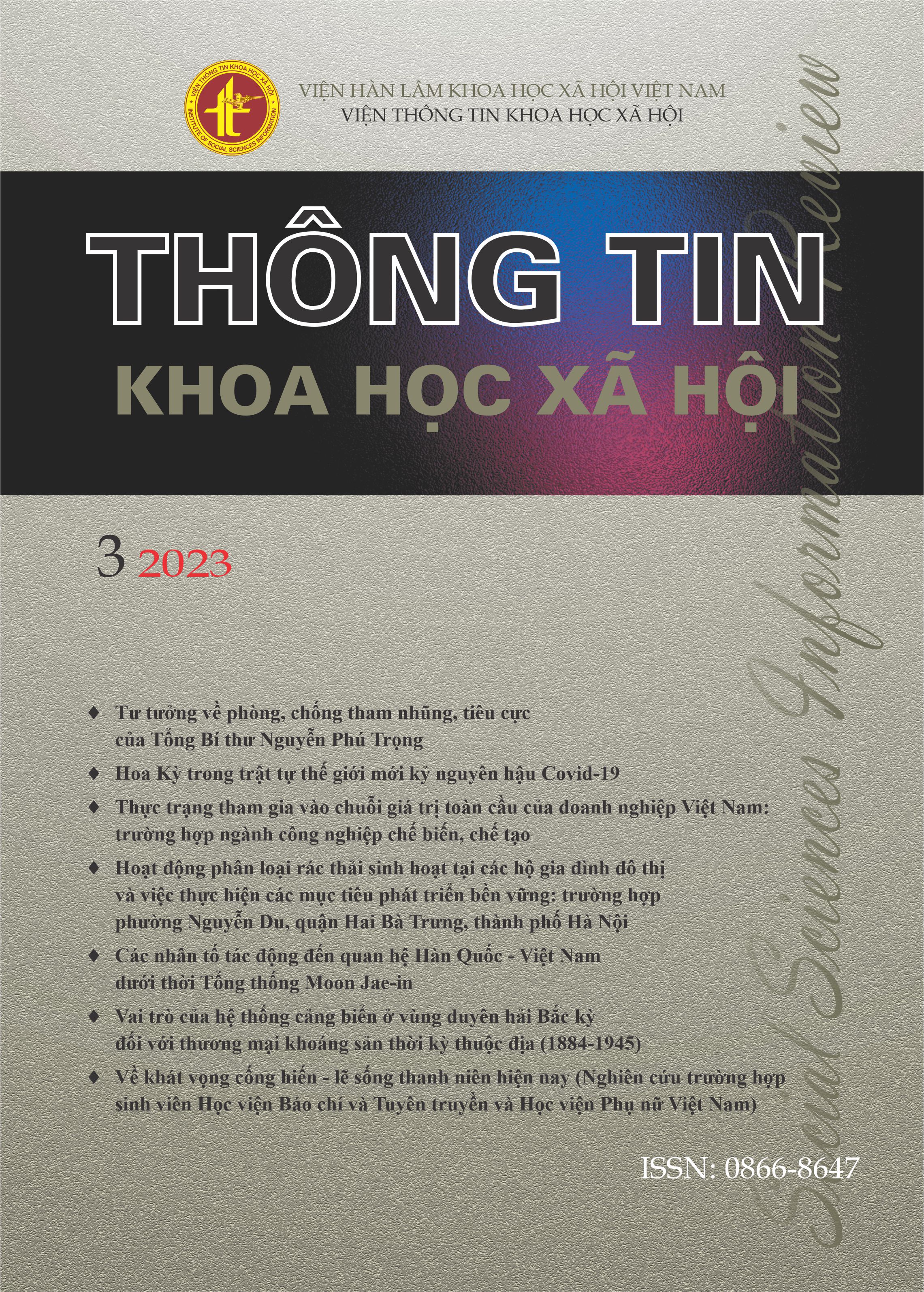
Household waste is usually divided into three types of waste, namely, recyclable, organic and inorganic waste. Household waste segregation is vital to the waste reuse and recycling to promote effective and sustainable waste management. This paper describes the situation of the waste segregation at source, in which the highest level of classification behavior observed is in recyclables, and the lowest in inorganic waste. Besides, the failure of waste segregation to meet sustainable development goals, such as gender equity, social equality, job creation and sustainable consumption is also identified. On that basis, the paper proposes solutions to enhance this work, contributing to ensuring the sustainable development goals.
Downloads
Download data is not yet available.
Downloads
Published
2024-08-12
Issue
Section
SOCIOLOGY
License
Tác giả xuất bản bài viết của mình trên tạp chí này đồng ý với những điều khoản sau:- Tác giả vẫn giữ bản quyền và trao cho tạp chí quyền xuất bản lần đầu tiên và sau [số tháng] phát hành tác phẩm theo giấy phép Creative Commons Attribution Licensecho phép những người khác chia sẻ tác phẩm đó với điều kiện nêu rõ tác giả và nơi xuất bản đầu tiên.
- Tác giả có thể ký kết những thỏa thuận riêng rẻ khác mang tính hợp đồng đối với việc phát hành không độc quyền phiên bản của tác phẩm in trên tạp chí này (v.d., đưa vào một kho dữ liệu của một cơ quan hoặc đưa vào một cuốn sách), với điều kiện nêu rõ nơi xuất bản đầu tiên.
- Tác giả được phép và được khuyến khích đưa bài viết của mình lên mạng (v.d., trong các kho dữ liệu cơ quan hoặc website của tác giả) trước và trong quá trình nộp bài viết vì nó có thể đưa lại những trao đổi hiệu quả cũng như giúp tác phẩm có nhiều địa chỉ trích dẫn hơn (Xem Hiệu lực của Truy cập Tự do).
